AI & Automation
2026 — Present Featured LUMEN Protocol
Open Binary Transport for Agent Societies
MIT-licensed zero-copy binary transport for AI agent societies: 115 MCP tools across 4 servers, 6 language implementations, and 37-58% fewer bytes on the wire measured against real MCP payloads.
Year
2026 — Present
Role
Author & maintainer
Tech Stack
7 technologies
Gallery
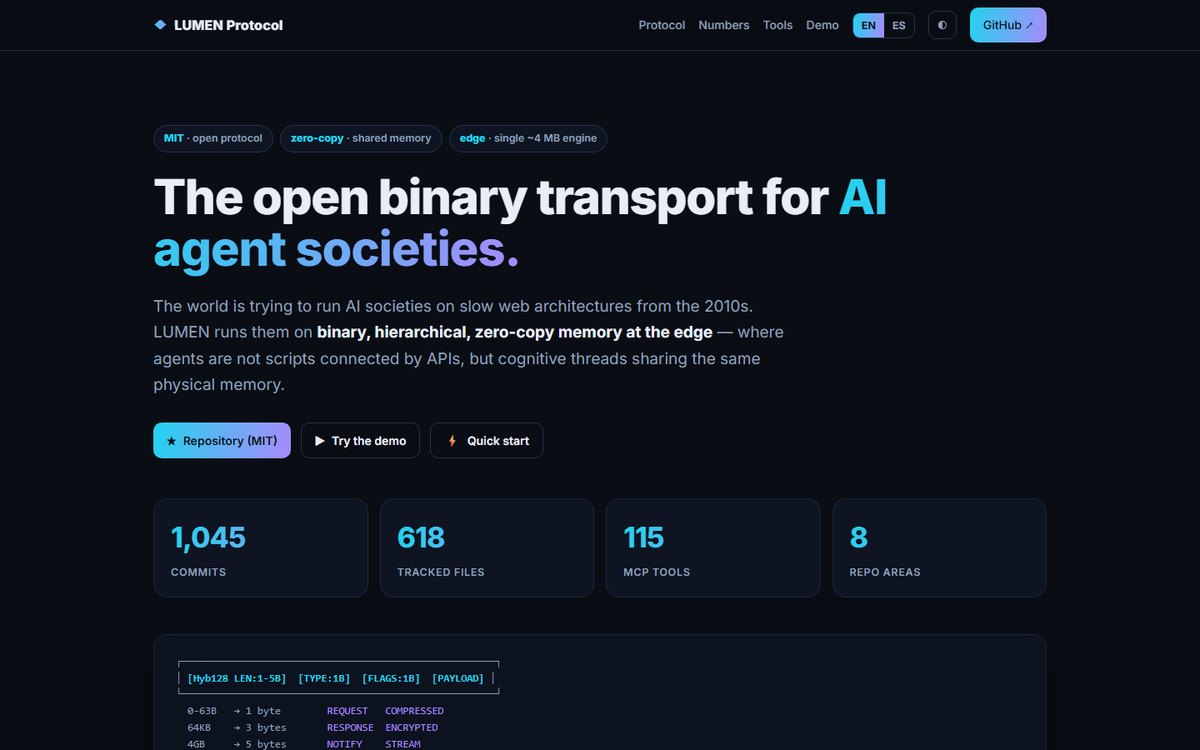
LUMEN Protocol
/ 1
The Challenge
Agent societies run on 2010s web architecture.
- Agents talk over HTTP request-response: every hop adds latency and the conversation state lives in nobody
- Tool calls are fat — the same keys are retransmitted on every message
- Agents cannot share state, so they cannot really work as a team
The Approach
Design a transport instead of gluing libraries:
- Hyb128 framing — 1/3/5-byte modes with O(1) skip, consistent across every binding
- Static plus session dictionary — repeated keys travel once, then by index
- Zero-copy shared memory — Level 2 mmap ring buffers, sub-millisecond latency
- Optional crypto — ChaCha20-Poly1305, X25519, capability macaroons, QUIC over TLS 1.3
The Solution
A protocol published as open source with six implementations:
- Rust reference implementation plus a 22 KB gzipped WASM build that runs in the browser
- TypeScript, Python, PHP (217/217 end-to-end tests) and C#/.NET bindings
- 115 MCP tools across four production servers: filesystem, web, thinking (81) and PDB (19)
- M-Light evaluator and MVM runtime: FOR 1 to 100 iterations 3.97x faster than the previous Python implementation
Key Results
- 37-58% fewer bytes on the wire vs JSON-RPC, measured on real MCP payloads
- 115 MCP tools across 4 servers, 6 language implementations
- 22 KB gzipped in the browser, ~4 MB native library
- 20,495 msg/s durable mailbox and 22,000 ops/s hierarchical store
Tech Stack
Rust WebAssembly TypeScript Python PHP C# MCP
$ cat project.json
{
"name": "LUMEN Protocol",
"status": "production",
"stack": [7],
"url": "lumen.cadences.app",
"results": [4]
}